Today's selection -- from Odessa: Genius and Death in a City of Dreams by Charles King. At 27, Sergei Eisenstein developed the iconic silent film, Battleship Potemkin: "Battleship Potemkin became one of his preeminent pieces and certainly one of the most copied works in film history. It was commissioned by the Central Committee of the Communist Party of the Soviet Union for the twentieth anniversary of the 1905 revolution, but by the time Eisenstein began the project, the end of the anniversary year was only a few months away. He and a vast team worked in Odessa and other parts of the Black Sea region for weeks, using the Hotel London as their base. To save time and money; they scraped together archival footage that could be used in place of new film, (The shots of tsarist ships steaming ominously toward the valiant mutineers are actually old images of the U.S. Navy on maneuvers, the giveaway being a small American flag visible in one scene.) In a mad rush at the end of the year, Eisenstein cut down some fifteen thousand meters of film into a running time of around seventy minutes. 'The fetters of space and the claws of time held our excessive and greedy fantasy in check,' he later wrote, surely with little inkling of the lasting success produced by just over three months of scenario writing, set design, shooting, and editing. "What Eisenstein injected into the story was its single most memorable -- and in large part imaginary -- element: the slaughter on the Odessa steps. Eisenstein's genius was to place the steps at the center of his film, a scene that he called in his memoirs 'the very core of the film's organic substance and general structure.' Ranks of soldiers and Cossacks fire on the striking workers. When a Cossack strikes a woman across the face with his cavalry saber, we know exactly what has happened in that gruesome and shocking scene, even though the director never shows the sword making contact with her upturned face; the woman simply turns her gouged eye full-on to the camera. In the climactic sequence, a baby carriage teeters on the edge of the staircase then slides horrifically down the granite cataract.
"In reality, there was no popular memory of a 'massacre on the steps' as the centerpiece of the violence of 1905. The major shooting occurred elsewhere in the city and involved not only the military but also a whole series of self-protection units organized by city neighborhoods to guard against bandits and the inciters of pogroms. The idea for the scene may have come from an illustration of the staircase that Eisenstein found in a contemporary French magazine while doing background research for the film in Moscow. In Eisenstein's retelling, the single bloodiest event of 1905 -- the murder of hundreds of Jews -- faded into the background. Through the film, Odessa was transformed from a place where Jews had been killed in the streets to a city remembered for working-class solidarity and opposition to the tsar's arbitrary rule. It was, to say the least, a heroic act of misremembering. "When Soviet audiences viewed the silent film, they were witnessing the birth of their own country -- a revolutionary nation that looked back to the heroes and martyrs of 1905. By the time the film was released in 1925, the Soviet Union had succeeded the Russian Empire as the de facto ruler of much of the Black Sea coastline, including Odessa. Yet it was a country without a history. Its ideology proclaimed youth and rejection of the past as the hallmarks of a new social and political order. Even its founder -- Lenin -- lay dead, his legacy uncertain and a host of former courtiers now vying for power. The Potemkin mutiny, in Eisenstein's talented hands, became the Old Testament of the Bolshevik Revolution, a series of events that presaged the triumphant changes of October 1917. "One of the last places Battleship Potemkin was shown was in Odessa itself. It had played at the Bolshoi Theatre and the First Sovkino Cinema in Moscow in December of 1925 and January of 1926, and when the American film stars Douglas Fairbanks and Mary Pickford saw it during a visit to the Soviet Union that summer, they hastened its release abroad. Charlie Chaplin pronounced it the best film in the world. It soon played to packed houses in Atlantic City, New Jersey, before arriving in Odessa later in the year. The film had been taken for a dry documentary elsewhere in the Soviet Union and had been screened to half-full houses. But in Odessa it was an instant hit ... "Battleship Potemkin is arguably the single most important cultural artifact in Odessa's modern history -- a piece of art that did more than any other to encapsulate the city's own image of itself and the way in which it would be remembered for generations to come. If portside hucksters and the mélange of East and West had impressed visitors for much of the nineteenth century, Eisenstein's staging of the Potemkin affair came to define the city in the twentieth. Eisenstein included all the basic elements of the incident that were passed down from the participants themselves, such as the crew's refusal to eat rancid meat as the impetus for the mutiny. But he added the heroic gloss that turned Odessa into the avant-garde of revolutionary change, providing a usable prehistory for the Bolshevik Revolution and, by extension, for the new Soviet state."
| |||||||||||||||



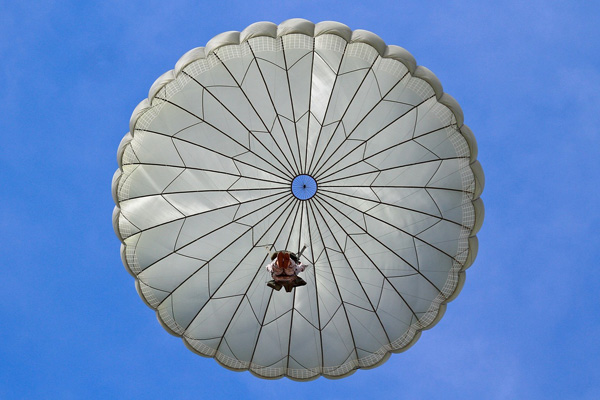
Probably you think that parachutes are made of silk. In November 1941 we stopped importing Japanese silk and by June 6, 1942 Dupont chemicals orchestrated the first jump in a nylon parachute by Miss Adeline Gray of the Pioneer Parachute Company. (I have never even seen a silk parachute and I am an FAA Parachute Rigger.) Exactly two years later every one of the thousands of parachutes in Normandy were fabricated from the superior nylon material. Every industry with weaving capabilities was turning them out! (I specifically remember "Milady's Hat Shoppe" being stamped on a reserve.) Dorothy Dandridge, as Bizet's Carmen, did not work in a cigarette factory but was a WWII parachute rigger in my all-time favorite opera, Carmen Jones. The toreador Escamillo was a champion prizefighter and Joe (Don José, Harry Belafonte) was being sent to the U.S. Army flight school.
There are no bigger wastrels in the world than the United States Government. The land of hundred-dollar monkey wrenches. Ever since going off the gold standard, printing presses have been running 24/7 churning out little green rectangular pieces of paper that we pretend are intrinsically worth something.
When parachutes were silk, there was every good reason to demand, by law, that they be opened, aired out and repacked. Every sixty days. Moth and dust (and a lot of other things) doth corrupt silk. Nobody changed the law. A nylon parachute, kept out of the damaging UV rays of the sun, will last well over a century. Nobody wants something that will last that long...more must be manufactured for the sake of the economy. So every five years or so perfectly good parachutes were...burned. The Marines had a big conveyor belt oven in Kaneohe MCAS where perfectly good parachutes were put on the belt and incinerated. About one hundred at a time. Well, melted, actually. Nylon does not burn; it melts into puddles. Those who ran the conveyor belt would tip off the parachute instructors about the date of "burn day", for a few bucks. We grabbed them off the belt before they, like Shadrach, Meshach, and Abednego, were consigned to the flames. We used these parachutes for our students who would purchase them for themselves if they were to continue in the sport.
Any jumper could pack his own main chute, but licensed riggers had to repack every reserve chute every sixty days and re-seal it with their own lead seal. For five bucks a pop! It is very much akin to a pilot's license for which you must pass muster under a picky FAA Inspector's steely eyes. If the chute did not open and was found to be defectively packed, the rigger would go to jail. So we were very meticulous!

One burn day it was raining so hard it was difficult to see fifty yards. I drove off with over ten chutes in the trunk, took a wrong turn out by the parachute loft and...wound up on the runway! Dousing my lights so as not to be spotted, I got back on the road. Behind me was a Marine police car, lights all ablaze and siren howling. There I was with over $3500 worth of stolen government goods in the trunk! The police had no doubt spotted me on Kaneohe's active runway. I wondered if I would be sent to the Portsmouth Naval Prison in New Hampshire, or straight to Leavenworth, Kansas. I rolled down the window, donning my best "Clean Cut American Youth With Sorrowful Mien Guise". A red-faced PFC was screaming at me. Slowly I realized that this was not about driving out on an active runway, not about stealing government property, but about not stopping my car and getting out and saluting while "Taps" was being played. At sunset, every day. Everybody stops what they were doing and salutes. An excellent tradition. It was so dark out I was not aware it was sunset and I certainly could not hear "Taps" with all the rain hammering my car. He had seen nothing of what I was worried about. Whew!
The next day I discovered a real gem in the trunk...a large training chute with thirty gores. Over 180 square feet more area than the usual! I had never seen one before but Mom took a picture of Dad under one at Ft. Bragg back in 1943. (The picture hangs on the wall right here.) It really did let you down more gently! Instantly it became very popular for other jumpmasters to ask to use for their own students. Sure, why not? I had saved this beautiful chute from being a molten, useless puddle! A friend asked to borrow it for his student's second jump the very next day. The DZ that day was a huge field with high-tension towers running near the boundary. Of course the student was cautioned to stay away from the wires. Like some sort of magnet, she went right into them. The nylon wrapped right around the wires! There was a blinding flash! The poor girl suffered first, second and third degree burns and was weeks in the hospital. Her father sued the pilot, the electric company, the land the wires were on, the owner of the airplane, and her jumpmaster. Happily, it never got out that she had been using a chute of mine. The parachute and most of the suspension lines were instantly melted. Tucked away safely out of the sun for decades, yanked from the voracious maw of an incinerator one instant, vaporized and melted in a millisecond the next. Apparently this was foreordained. Alas.
A merchant in Baghdad sends his servant to the marketplace for provisions. Soon afterwards, the servant comes home white and trembling and tells him that in the marketplace, he was jostled by a woman, whom he recognized as Death, who made a threatening gesture. Borrowing the merchant’s horse, he flees at great speed to Samarra, a distance of about 75 miles, where he believes Death will not find him. The merchant then goes to the marketplace and finds Death, and asks why she made the threatening gesture to his servant. She replies, “That was not a threatening gesture, it was only a start of surprise. I was astonished to see him in Baghdad, for I have an appointment with him tonight in Samarra.”
